Q: Dear Diamond Buying Advice, Can you help me find an eco friendly solution to buying a diamond? First off though, great blog! thanks for providing some interesting articles about diamonds and I have been reading through your advice to other people. I want to very soon buy a diamond but don't want to support the mining and digging up of the ground soil everywhere. What is the best way to go about buying a diamond without ruining the earth? I wish to propose with a diamond but am wondering if fabricated diamonds are all that good. What is your opinion about this? I know I could just not bother with a diamond ring but that doesn't sit right with me. I hope I am making sense. Is there any point in me looking at made diamonds that are not dug from the ground? I don't mind buying over the internet, I just don't want to be sold a dud. What are the things I need to consider when buying a made diamond? Thanks in advance for your help with this. I look forward to hearing back from you when you get a chance. Hopefully soon as I want to get this sorted and will hopefully have come to a decision within the next couple of months. (Christmas at the very latest, lol!) But yeah, whenever it's convenient. By the way my budget is $5000. that has to include the ring setting too. So I guess like $3500 to $4500 for the diamond and the rest for the diamond ring setting. I am in the US so don't have to worry about any additional import duties I guess if I buy from US companies. (I'm cool if you stretch it a bit, but I will try to keep it to $5000 total.) I am hoping for a 1 ct diamond, but I don't know if that is going to work. I heard from a friend that one carat is usually more than $5000. Ok, I hope I didn't ramble on too long. Anyway, I hope you can help me find something nice.
HH
A: Hi HH, thanks for your message. I totally get where you're coming from. I have heard of some people buying second hand diamonds in order to solve this problem. As a matter of fact I read an article yesterday about a couple who found a vintage store that sells good quality vintage diamonds (this was in Sydney Australia). They went there and had a look at the diamond rings on offer. They tried on a few and found a perfect fit which the woman decided was in the style that she really liked. A second option is to look at laboratory grown diamonds. The diamonds that are being produced now are identical to mined diamonds and some companies even source their electricity from renewable sources. I know of one diamond creation company that is even 100% carbon neutral. If you are wondering where to buy laboratory grown diamonds I maintain a page on one of my websites that lists the places I consider to provide excellent value and believe you will be very happy with the service they give.
see https://mytop10diamondwebsites.com/lab-created-diamonds/ Something that very few people realize is that laboratory grown diamonds are identical to diamonds that are dug up from the ground. Just yesterday the FTC in the United States ruled that lab grown diamonds are diamonds. It said that created diamonds should not be referred in to marketing as synthetics, but rather as lab made diamonds, man made diamonds, or even foundry diamonds. Now just because diamonds can be grown in a lab does not mean that you can find 10 carat lab grown diamonds. The big diamonds are very difficult to make in the lab just as they rarely form in the earth. Big diamonds are rare and will continue to be rare. Most of the diamonds that are made, luckily enough, are just the right size for engagement rings. Oh and if you have a look at the prices of the companies I listed you will find that you will easily be able to afford a 1 carat diamond with a very nice ring setting. Now you may not have as much variety among lab grown diamonds, but fortunately there are less unlovely ones among the available range. It's quite a bit easier to hunt for a good stone as they usually don't have a lot of visible inclusions as you would find in the more included mined diamonds. Most of the inclusions I have seen in laboratory made diamonds did not severely affect the beauty of the diamond. Though to be honest I have not looked at nearly as many lab grown diamonds as I have natural mined diamonds. Anyway, all the best with your diamonds hunting. Let me know how it goes.
-Thomas Stevens
Diamond Buying Advice
Friday, July 27, 2018

Thursday, May 10, 2018
Are these 2ct+ diamonds eye clean and good value?
Q: Are these 2ct+ diamonds eye clean and good value?
I think I have narrowed my search down to the below two:
2.06 H SI2

2.08 H SI1

Would
both of those appear eye clean? How about the twinning wisps - is that
something to worry about? They seem to be white and fairly small, even
though they go through the table.
In terms of setting, would putting this in platinum cause any issue?
thanks!!
A:Yes, they're eye clean IMO.
Twinning
wisps only become a major concern if they encompass more than a few %
points of the diamond. As long as they aren't too close to the girdle
it's usually fine.
Will look good in platinum.
Q: Thank you!! What do you mean "more than a few % points of the diamond" ? Do you mean specific locations (e.g. girdle) ?
A: Twinning wisps and feathers are breaks in the diamond. If they are too
big they threaten the integrity of the stone. If they are near the
girdle they risk getting larger if they are subjected to shock.
email your questions to:

email your questions to:
Tuesday, May 8, 2018
Could you please provide me with your opinion about this oval cut diamond?
Q: Could you please provide me with your opinion about this diamond?
https://www.jamesallen.com/loose-diamonds/oval-cut/1.01-carat-h-color-si2-clarity-sku-4796184
Thank you so much in advance!

A: I like it.
The inclusion on the table that is evident in the magnified image seems to be a clear crystal so it's not likely to be noticeable. Remember James Allen has a generous no questions asked return policy, but make sure to read the terms and conditions especially the last clause: https://www.jamesallen.com/guarantee/hassle-free-returns/. the cut quality seems to generate a decent amount of fire, which is real nice for an oval. I'd go for it.Q: Thank you SO MUCH for your reply! It makes me feel a lot better about what I picked!
One last questions if you don't mind...I see that the depth is 66.90%. I think I read online on a guide that for an oval shaped diamond it's recommended a depth of 58-62% and a table of 53-63%. Would the depth of 66.90% make this less sparkly?
A: It depends on other variables such as its length to width ratio. This is one of the reasons grading labs don't want to give fancy cuts a grade of excellent or any other level because there are tiny variables that are very complex to calculate. Generally speaking a deeper cut or a shallower cut will return less light to the eye of the beholder. Since this diamond has no noticeable bowtie effect it appears to be returning light quite efficiently.
email your questions to :
Wednesday, April 25, 2018
The jeweler says that the stone is a natural carbonado
Q: my girlfriend and I have been shopping for
engagement rings, and found one that we're quite a fan of. The ring
features a non-traditional center stone from a small husband-wife
jeweler.


The
jeweler says that the stone is a natural carbonado, and seems
reputable; that said, I'd like some degree of confirmation that this IS
indeed a carbonado. I asked about getting a certification for the
stone, and the jeweler was fine with it, but said that it would require
them to extract the stone and then re-make the ring.
As
it's a one-of-a-kind piece, I'm a bit hesitant to do that in case it
alters what we love about the design. Are there any ways, working with
the jeweler or an outside party before purchase, to confirm the
authenticity of the diamond without removing it from the ring?
A: It
may very well be a Carbonado, but what gives the jeweler the confidence
that it is one? When they bought it they would have to have been
reassured that they were getting the real deal.
The
International Gem Society tells us that while most black diamonds on
the market today are either superheated or irradiated to an almost black
color, natural black diamonds do exist, though they are extremely
rare.
Black diamonds are as a rule not more expensive than colorless diamonds.
For reference see this 3 carat oval from one of the world's foremost experts on fancy color diamonds. https://www.leibish.com/black-diamonds/fancy-black-oval-31234
As you can see the above site provides a GIA certificate with their diamonds.
Without
one it is better to assume that it is a treated stone. Just check
amazon.com and see how much black (irradiated) diamonds go for.
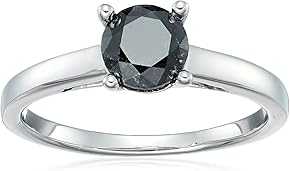
Some tests can not be done , such as specific
gravity comparison of the weight of the isolated stone to the same
volume of water. This test only proves it is a diamond, not whether it
is a natural Carbonado,
However it's up
to you. What is the significance of knowing that the diamond is what
it's purported to be? Satisfaction, yes. But insurance and resale value
could be factors for you. Will the in-house certification cut it for
those? Maybe. But GIA holds a lot more authority.
Q: This
is really helpful, thanks for the feedback. This particular ring is
only about $2.2k, and the center stone is 1 carat, so that's less than
the cost of most colorless diamonds I've seen. As far as I can tell,
they have confidence in the authenticity on the word of a sourcer that
they trust.
In your opinion, it sounds like I should go with the certification?
A: Without certification you may as well buy an irradiated stone. This is what certification is for. So you can be certain.
Q: Thanks so much, that makes complete sense.
email your questions to
Sunday, April 22, 2018
Help Choosing a Cushion Cut Diamond
Q: I've been
looking at 8 faceted cushions (as opposed to 4) and narrowed it down to
these three. I've looked at them so much that they look pretty much the
same...
any opinions?? This will be on a white gold pave band. Each diamond is around 3.7k
A: That first one looks pretty amazing for an SI1. If that's correctly
labeled then you have found yourself a nice stone. The grading report
usually has a bit more information on the type of inclusions than can be
made out from the photo. Did you get a chance to look at the lab
reports?


Q: Yeah, I have the GIA reports. Once it points out the inclusion, I can't unsee it!
and here
is the side and bottom views. I figure my girlfriend will never see it from
the bottom, so those inclusions aren't that big of a deal.
A: Yep. But at least you know it's legit. Seems like you found a sweet deal. All the best.
email your questions to:
Friday, April 20, 2018
Cushion Cut Purchase Recommendations
Q: Hi, I was wondering if you could help me. I'm looking for a cushion cut diamond in the 9-10k range. Obviously if I can find something
exceptional for less, I may want to put that difference into a possible
three stone setting. Do you have any tips for finding good value? Can you explain diamond fluorescence?
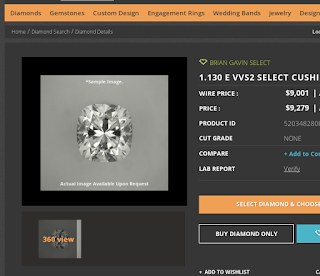
A: The cut quality of Cushion cut diamonds is not as easy to determine from a grading report as round brilliant or princess cuts.
Browsing online jewelers that have high resolution images is a must. However if they don't display an image many jewelers will be able to send you an image upon request.
Like this one:
Diamond fluorescence basics:
When under ultraviolet light, fluorescent diamonds glow.
This effect looks pretty awesome in a nightclub.
In
daylight, though, the glow sometimes interacts with the light that
would make up the diamond's fire and brilliance, essentially reducing
its sparkle.
The result is a reduced brilliance in daylight.
This does not occur in every single fluorescent diamond.
But it is not possible to be certain unless it has been previously checked.
One jeweler that screens fluorescent diamonds is Brian Gavin Diamonds. https://www.briangavindiamonds.com/diamond/brian-gavin-blue-diamonds-with-fluorescence/
email your questions to
Sunday, May 3, 2015
Fancy a little color in that diamond?
Today's blog entry will be on the subject of colored diamonds.
 (see leibish.com for examples of different grades of colored diamonds) Fancy Vivid is the grade given to diamonds with the highest level of saturation as can be seen in the chart.
First I'll run through the definitions:
Fancy color diamonds: Diamonds which have a vivid or intense color. The hue of these diamonds can vary across the entire spectrum of colors.
Each colored diamond will vary in intensity and will therefore be given a classification in regards to how intense the coloring is. It will be classified under one of the following nine saturation grades:
- Faint,
- Very Light,
- Light,
- Fancy Light,
- Fancy,
- Fancy Intense,
- Fancy Vivid,
- Fancy Deep,
- and Fancy Dark.
The graphic below shows GIA's Fancy Color Grade interrelationships.
(see leibish.com for examples of different grades of colored diamonds) Fancy Vivid is the grade given to diamonds with the highest level of saturation as can be seen in the chart.
This is highly desirable, and naturally exceptionally rare.
Something else I wanted to mention is that faintly colored diamonds, or should I say, sub-faintly colored diamonds, which have less color than those with an official designation of "Faint"are unsurprisingly rather common.
It's the colorless and the intense colors that are rare and hence their cost. Colorless diamonds are assigned the letter "D" when their color is graded by a GIA lab. A diamond with a very slight increase in color (when compared to a D) be assigned an "E", followed by an "F", then a "G" etc, all the way down to Z. Very few people seem interested in diamonds that fall between "K" and "Z".
Fancy colored diamonds have just a bit more color than a "Z".
X-Y-Z stones that have yellow or brown as their color do have enough color to be counted as fancy color diamonds.
Each group of gemological labs has its own grading system, but the dominating grading system is the one developed by the Gemological Institute of America (GIA).
Yellow is the most popular fancy color. It appears to have become more and more popular and a number of celebrated public figures have been seen sporting yellow diamond rings. Here are some of the people seen wearing yellow diamonds in recent years: Heidi Klum, Jennifer Lopez, Jessica Alba, Megan Fox, Kelly Clarkson, Anna Kournikova, Carrie Underwood.
Yellow diamonds stand out because they do get noticed, and they are known to be rare. About 10,000 times as rare as white diamonds.
Yellow diamonds are much rarer than white. The yellow color in diamonds is caused by nitrogen replacing carbon atoms in the diamond's molecular structure. Higher levels of nitrogen in the stone's composition results in a deeper color.
Since vividly colored diamonds are indeed rare, you will find that cutters try their best to retain as much of the diamond as possible. Another priority will be on shaping the diamond in such a way as to retain the intensity of the diamond's color. If a colored diamond has not been cut to be perfectly symmetrical it will usually be because this was a necessary compromise to retain more size rather than lop off a few more corners to get it into perfect symmetry. If you prefer your diamond to be perfectly symmetrical, keep looking. You can find them.
Thursday, October 18, 2012
A Diamond's Hardness
How hard is a diamond? Can they break or chip? How do you avoid getting a diamond that would have a tendency to break?
Diamonds must be breakable, since diamonds for use in jewelry have been cut by something to get them into the right shape. How do diamond
cutters cut diamonds if diamonds are the hardest substance on earth?
If we know how cutters do it, then we can avoid doing the same thing.
It is evidently an
impossible task to break or cut something if there isn't a tool that is harder than whatever it is you
are trying to cut.
Try cutting bread
with a slice of butter and you'll know what I mean.
So how do they do it? Diamonds are
hard, harder than steel. What do cutters use to cut diamonds? Light sabers?
As a matter of fact
that silly answer is not too far from the truth. Lasers are employed to cut
diamonds.
Centuries before
lasers were invented cutters had to come up with a way of shaping diamonds. They did. And this is how: they would fasten a diamond to the end of a stick, spin it and make the diamond spin very fast. This spinning diamond would make
slightly off center contact with another diamond, also on a spinning stick.
Once the two diamonds made contact they would wear off the rough edges of each
diamond, in effect sharpening each other. This process is called bruting and is
still how the initial shape of the diamond is
worked on even to this day. Maybe a little more sophisticated, but
essentially the same process.
In order to get the
facets of a diamond cutters are able to cleave diamonds with a forceful blow.
This is due to the fact that diamonds, though very hard, are also brittle.
Imagine a square
grid of square blocks. And on top of this grid is another grid of exactly the
same blocks. Keep imagining layer upon layer of blocks, until you have one
giant cube.
This is how the
carbon molecules in a diamond are arranged. They are in neat and very perfect
rows. This makes them very hard. But if you hit them right on one of the rows,
you could dislodge an entire section.
When choosing a
diamond for a ring, avoid diamonds that have a mention of a "feather"
in the grading report, or diamond certificate. Feathers may sound harmless
enough, but it indicates that the diamond has suffered stress along that
section, or row, of molecules. That has weakened it in that area and another
strong shock to that spot could cause the diamond to fracture or chip.
Send me a message if
you want help in finding a nice diamond with excellent quality characteristics.
Friday, October 5, 2012
The Emotional Factor Involved In Buying a Diamond Ring
Buying diamonds can
be a risky venture. Why? Because diamonds differ in value based on a range of
factors. A bigger diamond isn't necessarily a better choice. If you are not familiar with the various kinds of diamonds available you'll be glad someone is there to guide you through and recommend the best options for you. A good diamond salesperson will not only consider your budget but will make you aware of other factors you need to think about as well such as the style of the setting and the durability of the ring design. Without a comprehensive diamond education
you can only rely on the expertise of the salesperson to help you make the best choice for you. A knowledgeable and caring salesperson will be able to guide you through the buying
process. This is very valuable, and one of the reasons many people still go to local jewelers even though it is possible to get some pretty decent discounts online. Those who do buy online have to educate themselves, yet very few people will take up a study course just to prepare themselves to buy something that they will only buy once in their lives. Even when buying at a jewelers, this lack of knowledge can be , and has been, exploited by unethical merchants. If you are unsure about what the various diamond terms mean then the chances of getting ripped off are considerably higher. Due to the wide variety of options one is faced with it is possible to get hoodwinked by unscrupulous sales people. This is why the first and foremost consideration when
buying diamonds is to look for a reputable dealer. Ask friends and family if
they have had any good (or bad!) experiences. This is going to help you
immensely in working out where to buy your diamonds. I should add that even the most knowledgeable people, who are practically diamond experts, have been scammed by devious dealers. So getting educated about diamonds is still not a fool proof way to avoid falling victim to a con. Everyone no matter how knowledgeable they consider themselves should go to a recommended jeweler. And make sure the jeweler is close enough to where you live so you can go back to them and talk with them face to face if needed.
If you are far away from home when you buy your diamond you'll have no recourse once you get back home as the store is far away and there will be very little you can do.
This is why it is highly , highly, highly recommended to only go to a jeweler
within your area. It's a bad idea to buy diamonds when you are far from home,
whether on a honeymoon, or any kind of holiday, business trip, or visiting
relatives on the other side of the country, or worse, the other side of the world.
The experience of
buying a diamond is a very emotional experience. Yes, an
emotional experience. You may be thinking, What? What does that mean? Is my
girlfriend going to start crying?
No. Probably not.
The kind of emotionally charged situation I am talking about occurs from the high level of concern on the guy's part, mostly to do with the expense, but also from wanting to please his girlfriend, and the girl's concern for his stress levels as well as the hope
that he'll be happy with the diamond she likes. The guy will be going over the
numbers in his head trying to convince himself that he can handle the expense,
while the girl will be thinking about how nicely this diamond is going look and she will also have her friends' reactions in mind. This combination creates an interesting dynamic. Once they have narrowed the choice down to a couple of diamonds or maybe one diamond her
instinctive behavior at this point will be to be affectionate toward the guy. this usually happens once she sees
there is a particular diamond ring that he has shown only moderate resistance
to.
Diamond sales staff, if they are good at what they do, will be
aware of the little signs that a couple displays when they are ready to buy. It
is going to be nearly impossible for any attentive sales person to avoid noticing the
tell-tale body language, because it is repeated so frequently by the many
couples who come in to the store with the intention of buying.
Emotions can shut down our logical thinking, and usually do. At this stage many people really can't focus on a lot of things. This is why everyone can be vulnerable and would be much better off going to a jewelry store that has been recommended by their friends as being trustworthy and reliable.
Naturally it is going to be hard to ignore the cost savings to be found by online jewelers. Some of the same things apply if buying online: buy from jewelers who have taken the same ethical way of operating which they applied in their brick and mortar store to their online presence. Getting recommendations from family and friends is still a good idea. Most of them would very likely not recommend buying online if they have never done so. They may even be shocked that you are considering doing such a thing. Mind you it is possible they might change their tune when they hear how much you can save. But think of this. Is it worth saving $2000 only to regret the diamond you end up with?
I know many people that would be unable to hear the rest of what I have to say once they have been told how much money they can save by buying online. What!? I can save $2000?! That is all they'll be able to think of when they hear that. Everything else is "Yeah, yeah, bla, bla, bla. hmmm save $2000".
That is another example of the logical thinking shutting down when overwhelmed by emotion, in this case it is a kind of greed. Also known as lust. You can see why "lust" made into the catholic "List of Top No-No's" also known as the Seven Deadly Sins.
That is another example of the logical thinking shutting down when overwhelmed by emotion, in this case it is a kind of greed. Also known as lust. You can see why "lust" made into the catholic "List of Top No-No's" also known as the Seven Deadly Sins.
There are ways of buying diamonds online where you won't get ripped off. Of course there are. There are a number of well respected jewelers that sell online and have a huge and growing list of satisfied customers. I even compiled a list of recommended diamond jewelers.
However the temptation, when shopping online is to compare only the prices. When buying diamonds there is so much more than just price. For example, how many days are you given for examining the merchandise? Many places only give seven days. I find this an unreasonable amount of time. Ten days should be an absolute minimum. It is also important to have a clear line of communication with the jeweler. Do they answer the telephone? Do they reply to emails? Is it just a one man operation or do they have a dedicated team looking after their customers? Do they offer a generous return policy?
Do a bit of homework and you'll be very glad you did.
Thursday, September 27, 2012
Asscher Cut Diamonds
Gwyneth Paltrow,
Jessica Alba, and Vanessa Lachley have all chosen to wear diamonds cut into the
"Asscher" shape. This particular way of cutting a diamond was created
by the same diamond cutters who cut the famous Cullinan I & II diamonds, Joseph
Asscher and Abraham Asscher. Those two diamonds make up part of the British
crown jewels. Two generations later, in 1999, Edward Asscher reworked the
original design. He added 16 more facets to the Asscher cut calling it the
Royal Asscher. The classic Asscher cut has the same amount of facets as a round
brilliant which is 58 facets. The new
design is patented and is available through the list of retailers found on
RoyalAssher.com.
It doesn't look like there are any retailers listed on RoyalAssher.com that list Royal Asscher diamonds that you can browse through. The best option is to call them up and arrange an appointment.
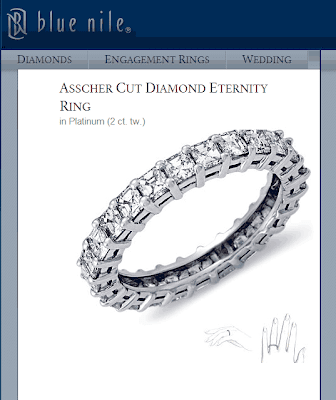
Asscher diamonds work well in Eternity rings, due to their shape. Arranging Asscher diamonds in a row still allows space at the stones' corners which give the prongs some space to hold the diamonds in place as you can see in this photo of a diamond eternity ring sold by BlueNile.
Wednesday, August 22, 2012
The Key To Finding The Best Diamond Studs or Earrings
Question: Hi Diamond Buying Advice, This may sound like a silly question but if I get diamond studs for someone as a present what do I need to know? I don't know if the color is the most important thing or if I should be worrying about inclusions, or what. I just really want them to shine. Also what is a good size. I figure that they don't have to be as big as a ring's diamond. Thanks for your help. It is a gift for a 17 year old girl.
John V.
Answer: Hi John V. I am in complete agreement with you about studs needing to shine. As they are at eye level they are going to be much more noticable than a ring would be most of the time.
And diamonds are just remarkable when they really sparkle and shine. There are a couple of things that when combined together make for a magnificent combination.
First let's start out with the "Who".
Who is going to be able to provide you with something that is outstanding. If you get your diamond from someone who is very meticulous and extremely selective in the diamonds they will even begin to work with, then you have a great start. Brian Gavin Diamonds is one of the most fastidious diamond cutters. His attention to detail is simply unparalleled. His selection process is extremely particular. The quality he demands from his providers is known throughout the industry. That is just the start. From there he applies his signature cuts, which just transform a beautiful stone into an incredible work of art. Every time I see a Brian Gavin Diamond I see a work of perfection.
Nest we may focus on the question of "What".
What are the specifications? If you are getting a Brian Gavin Diamond you already have a high quality work of art. And we can ensure that within that range we are getting the best of the best. So we choose a diamond which has very little to no coloring. The closer to D on the color scale the better. That means we first see if a D color is available then E, then F, then G, and so on. However try not to go past H, if you really want the clearest sparkle and fire.
The Truth Studs
See the Truth Stud Earrings here:
http://www.briangavindiamonds.com/diamond-earrings/studs/truth-studs-14k-white-gold-5773w14
In regards to shape and size Brian Gavin's experts say:
Generally speaking, for any shaped face, round brilliant diamonds are a great choice for a stud earring. They’re a classic. Broader faces may also wear the more square shape of a princess cut diamond. In any case, the size of the diamond should harmonize with the size of the wearer’s earlobe. Larger is not necessarily better. A well-cut, high-performing stone is always preferable to ensure the greatest brilliance and the best value.
If you choose a Signature Hearts and Arrows from Brian Gavin Diamonds I will have to warn you:
You may never buy a diamond from anyone else but Brian Gavin Diamonds ever again.
Here are the Hearts and Arrows:
http://www.briangavindiamonds.com/diamond/brian-gavin-hearts-and-arrows/
The process is to choose a diamond, and then continue shopping and choose a set of studs. (or the other way around works too)
On the Heart and Arrows page, once you click on Search Now you'll see a slider which shows what sizes to display. Slide it a little to the left so it shows some sizes smaller than 0.6 ct. You may like to choose between 0.35 ct and 0.50 ct. as those sizes are not too small, not too big.
John V.
Answer: Hi John V. I am in complete agreement with you about studs needing to shine. As they are at eye level they are going to be much more noticable than a ring would be most of the time.
And diamonds are just remarkable when they really sparkle and shine. There are a couple of things that when combined together make for a magnificent combination.
First let's start out with the "Who".
Who is going to be able to provide you with something that is outstanding. If you get your diamond from someone who is very meticulous and extremely selective in the diamonds they will even begin to work with, then you have a great start. Brian Gavin Diamonds is one of the most fastidious diamond cutters. His attention to detail is simply unparalleled. His selection process is extremely particular. The quality he demands from his providers is known throughout the industry. That is just the start. From there he applies his signature cuts, which just transform a beautiful stone into an incredible work of art. Every time I see a Brian Gavin Diamond I see a work of perfection.
Nest we may focus on the question of "What".
What are the specifications? If you are getting a Brian Gavin Diamond you already have a high quality work of art. And we can ensure that within that range we are getting the best of the best. So we choose a diamond which has very little to no coloring. The closer to D on the color scale the better. That means we first see if a D color is available then E, then F, then G, and so on. However try not to go past H, if you really want the clearest sparkle and fire.
The Truth Studs
See the Truth Stud Earrings here:
http://www.briangavindiamonds.com/diamond-earrings/studs/truth-studs-14k-white-gold-5773w14
In regards to shape and size Brian Gavin's experts say:
Generally speaking, for any shaped face, round brilliant diamonds are a great choice for a stud earring. They’re a classic. Broader faces may also wear the more square shape of a princess cut diamond. In any case, the size of the diamond should harmonize with the size of the wearer’s earlobe. Larger is not necessarily better. A well-cut, high-performing stone is always preferable to ensure the greatest brilliance and the best value.
If you choose a Signature Hearts and Arrows from Brian Gavin Diamonds I will have to warn you:
You may never buy a diamond from anyone else but Brian Gavin Diamonds ever again.
Here are the Hearts and Arrows:
http://www.briangavindiamonds.com/diamond/brian-gavin-hearts-and-arrows/
The process is to choose a diamond, and then continue shopping and choose a set of studs. (or the other way around works too)
On the Heart and Arrows page, once you click on Search Now you'll see a slider which shows what sizes to display. Slide it a little to the left so it shows some sizes smaller than 0.6 ct. You may like to choose between 0.35 ct and 0.50 ct. as those sizes are not too small, not too big.
Subscribe to:
Posts (Atom)
-
Q: Dear Diamond Buying Advice, Can you help me find an eco friendly solution to buying a diamond? First off though, great blog! thanks for p...
-
 Question: Hi Diamond Buying Advice, I am keen on investing in diamonds. Where can I find wholoesale diamonds at good prices? I want to in...